Sunday, December 4, 2011

Home Again, Same Day


So my parents used to say, sing-song fashion, when we'd arrive back from a trip to the playground or the museum.

It's a chilly Friday afternoon on the Upper West Side, my childhood home.  I haven't been back for a while, and every time I am I'm amazed at how little things have changed.  A different set of paperbacks up for informal exchange on the table in the lobby of 838 West End, maybe.  New scaffolding up across the street.  A new resident on the 6th floor, or an old one who's died.  Same old neighborhood. Same old synagogue next door, same Sal and Carmine's slice (best pizza in the world) around the corner on Broadway.  Same old Ilya, the Russian doorman who seemed elderly when I was fourteen but who now impresses me with his keen-eyed vitality.  I shouldn't be surprised, as this is the same ageless Russian who ran marathons up into his sixties.  Ahh, Ilya, they don't make them like they used to.  I remember in the winter it was (and surely still is) his habit to move his desk set-up inside the lobby's inner doors where he's safely out of range of the chill.  When building residents would come in, Ilya would bark at them in his rough English to please shut the outer door.  "Shut door, shut door! Please!"  "He's the doorman," a friend once marveled. "Amazing."

At some point during my college years, Ilya and I became aware of one another's interest in chess (maybe I saw him looking at the chess section of the paper, or maybe, fiending for a game, I figured he was Russian so there's a good chance).  I'd grown up with a healthy hunger for the game, after many frustrating afternoons of my dad mercilessly thrashing me even when starting down a rook (or maybe he went a little easy, but I don't remember him ever letting me win).  He'd show me positions out of the world championship Fischer-Spassky match and tell me a little of the lore of the great game.  Anyway, fast-forwarding back to the less distant past, this all resulted eventually in a few games with Ilya at the big table in the lobby on my father's beautiful old Czech or Hungarian board.  Ilya would sit so that he could vaguely face the entrance, but in our 10 and 15 minute blitz games I doubt he had time to do much of his trademark doorkeeping.  I'd put up a fight, but he beat me most of the time--a little less often as I got used to his steely confidence and Russian interjections.

This time as I re-enter the building and spy old Ilya with his winter coat and bright, ice-blue eyes, we give each other a warm handshake. After the usual enquiries as to the location of my chess clock (for the record: location unknown, but possibly somewhere in Vermont) Ilya makes a further foray into English-language conversation.  This surprises me, because over the last years he's seemed to slip more and more into Russian, as if our warm regard and shared interest in chess obliterated the language barrier. But this time, just when I've started to think he's given up on English altogether, he opens his conversational gambit in my mother tongue: "Not married," he asks?  (Or maybe it was "where is wife?") Sensing his disappointment in my continued a-nuptial state, I try to meet him halfway: "too old," I reply? Two or three syllables is pretty safe and less likely to engender spurts of rapid-fire Russian.  Ilya's eye twinkles as he delivers the line I've unwittingly set him up for.  "Too young!" he says warmly, wistfully.  We all laugh, me and him and my mother who's there with us in the lobby.

Ahh, youth.  I'm twenty-seven, an age that feels just old enough to be no longer really young.  How many people have families, mortgages, bald spots, ulcers at my age? Any ten year old could tell you I'm a grown-up. But, on the cusp of the full maturity that our society seems to grant only to those over thirty, I'm also old enough to see myself as very young in relation to the average grown-up.  And yet again, old enough to know how it accelerates as it goes, how if I make it to Ilya's age (70? 80?) I'll look back and autumn 2011 will seem accessible, just a string of days and nights back along the line like so many dashes in the rearview mirror.

I told my mother recently that even ancient history doesn't feel that remote to me anymore.  It used to take a herculean effort of the imagination to picture the nineteen fifties as a real time, when real people made real decisions.  Those haircuts!  Those cars!  Those exclamations!  They can't be serious!  But I lived through the nineties, I've seen photos of myself in middle school, and I am forced to admit none of us is entirely above the fickle winds of fashion.  Once I was able to entertain the fifties as genuine, the ages fell like a row of dominoes.  No TV and airplanes, check.  No cars, no telephone, OK.  I mean, I've been to places where the cell phone is the only one of the four to be a major fact of life, and from there I figure it's only a hop skip and a jump to ancient Mesopotamia.  Hunter-gatherers sheltering in a cave ten thousand years ago were probably telling variations of the same dirty jokes that I heard in a Portland bar last week (even their "paleo" diet is back in style).  Hell, the cutting edge Chinese herbal formulas I'm learning in school date back almost 2,000 years.  People don't change all that much, though their attention spans get shorter.  I admit, this did make me feel old: our twenty year old neighbor stopped by on Halloween while my roommate and I were watching Rosemary's Baby and got up complaining that everyone in the movie was old and nothing was happening. Only the son of Beelzebub, girl!  Sans special effects, it was a tough sell.

Yeah, time is an awful weird animal.  The same friends I once played Super Mario and rode skateboards with are now lawyers and med students and ninth grade teachers.  The father I grew up with as a punning, pipe-smoking, intense but playful presence is being autopsied, his brain for research on fronto-temporal dementia.  Few traces of his last five years remain in the apartment; as I remarked to someone in the week or so after his sudden death, it's as if (what I imagine to be) the normal death process took place in reverse.  While we were losing him, imperceptibly and gradually but inexorably, we de-accessioned many of his belongings: scores to the Columbia music library; boxes of CD's to friends, clothes to the salvation army.  He traveled lightly on earth, didn't leave a whole lot behind.  Not  a lot of material stuff, that is.

Before the post-mortem gathering I've flown back to the City for, I find myself tromping the familiar avenue blocks down to his favorite neighborhood wine and liquor shop, perusing the aisles and picking up the wines he was partial to (Rhone and Southern Italian reds, Alsatian whites).  I've inherited or at any rate acquired much of his expensive taste but less of his frugal nature, and this seems like an occasion to splurge a little.  It feels like a while since I've walked this stretch of Broadway, perused the wine racks at Gotham, passed the 96th street taco cart with its meaty aromas and the scarf and pashmina vendors gearing up for the holiday season.  Overheard the patented NYC hustle and bustle in three or five languages in as many blocks.  On the way home, sun glaring against the two newish skyscrapers here on Broadway, I take a moment of vicarious pleasure in the street chess two South American booksellers are engaged in, and I think once again of Ilya, whom I'll disappoint again this visit by not making time to stop in the lobby for a game.  Next time, I tell myself, I'll dig out that clock, I'll bring down some tea (which Ilya will refuse) from the apartment and we'll make an afternoon of it.  My dad, I think, would approve.


Tuesday, November 29, 2011

The Guru Who Almost Was


A few days ago, during my sporadic Ill Wind housecleaning, I stumbled upon an orphan post from July 2010, never published.  The post, re-printed below, begins to spin a yarn about what seemed a serendipitous encounter with just the sort of ritual practitioner of Ayurveda that I was hoping to connect with during my Fulbright year in Kathmandu.  Events played out a little differently than I was expecting when I began composing, however, and the piece lay there unfinished.  Without further ado, then, an artifact from the archives:

                                                                *          *          *

A rainy morning in Kathmandu, finally proper monsoon downpour.  I've been up since dawn, squatted on the toilet for a while in the grey light, taken a bracing cold shower, and meditated a scant, distracted few minutes before sweeping out the door with a Chinese umbrella and a plastic bag of fruit, down the alley and up the street through fresh rivulets and growing pools.  At the next alley I turn right and duck into a little doorway next to a neighborhood Ganesh temple, a simple aniconic stone decked with flower garlands and vermilion.  On the wall next to the doorway is an old handwritten poster with a mantra to Hanuman, the brave monkey king largely responsible for the rescue of Sita from the clutches of Ravana and purveyor of courage and strength.  Under the mantra is a simple descriptive advertisement printed out in Nepali for the services of a baidya, or healer, named Padamnath Agasti.  It lists cures for "gastric," "sugar," and "pressure," as well infertility, jaundice, and a host of other ailments extending beyond what Americans consider the role of a doctor.  Remedies are achieved with herbs or by  tantra and mantra and the shamanistic technique of jharphuk (brushing and blowing).  The baidya here is a Hanuman bhakta (devotee), and his cures are by the grace of the monkey king (who, Padamnath-ji will soon insist, can be found living in a cave in South India).  It is this man I am here to see.  He has offered himself as my teacher.   

Life is funny like this.  In 10 months here I wanted nothing more than to meet an embodiment of the living tradition of Ayureda who was willing to pour some of that nectar into my vessel.  Perhaps my vessel wasn't empty enough; it seemed at the time that no one was willing to teach.  The hoped-for doors weren't opening.  When I met Keshab Kavi Baidya, one of the lasta rasa shastra alchemist-pharmacists in Nepal, it was too late.  He was already sick and no longer had any laboratory space in which to make the important bhasma medicines.  I found out after I left, almost exactly a year ago, that he died shortly after my last visit.  All in all, circumstances conspired against my delving deep into that particular ocean.  My 10 months here accomplished plenty else, if I recall that at the beginning I had ideas about pursuing anthropology.  I'm no longer interested in objectivity, if indeed I ever was, nor in theory divorced from practice.  Which is to say, I now fancy that I'll eventually transform myself into some sort of baidya myself.  That gets ahead of me, however: I don't think I had realized a year ago how much of a transformation it would be.

A year later, I return to find Kathmandu much the same as ever, except maybe for larger private vehicles on the street (VW SUV's?!) and infinitesimal progress on the Japanese-funded road project connecting Bhaktapur and Kathmandu across the width of the Valley.  The place hasn't changed much, but I find that I have.  A reaction has been set in motion, the result of time ripening and of a catalyst.  Old paths through the city, literal and figurative, no longer hold the allure they did, and new doors are ajar and ripe for exploration.

This particular passageway between Ganesh and Hanuman I stumbled onto through what Michael Gruber calls (in referring to god's work) a "conspiracy of accidents." A poster in a tea shop down the street from our guest house, a whim.  Following the directions on the poster I found the baidya seated in his room with a client (though that word, along with "patient," rings false here), rubbing her down with a mala of rudraksha beads.  I explained quickly that my companion and myself were well and had come to chat, and he beckoned warmly for us to sit.  Soon, to my surprise, he was telling me what he could teach me...

different paths.  crossroads.  I ching omens.  Hanuman and indications of the need for a warrior spirit.  strength for what is to come.  paths leading to paths...highway?  patience.
paths or windtrails on the sea?  paths we make

                                                                   *          *          *


11/29/11

So that's what I found in the bowels of this blog's archives, and that's how it shall stand; perhaps reading my recently deceased father's old journal has instilled in me a reticence to alter the historical record, even in such a trifling way as this.  I didn't finish the original post, I think, because the story I was spinning took a couple further left turns and ended up petering out--no mystical apprenticeship or Ayurvedic secrets forthcoming from this charismatic ritualistic physician.  I can't remember the content of the "I Ching omens" referred to in the last fragment; Hanuman and the warrior spirit are clear enough (who doesn't need some of that? Especially given the turbulent times that were to follows.) Anyway, what ended up happening in those early monsoon season weeks in Nepal the summer before last was this:

I met with the baidya in question a couple times but balked slightly when it became clear his teaching was to consist primarily of spiritual practices and pursuits.  I was most interested in techniques, quick and dirty, from the toolbox of esoteric Ayurveda; he wanted to whisper a secret mantra in my ear, to have me adopt a particular set of mantra and visualization, to take me on as spiritual son. He was a compelling man, dedicated, and pure in his intentions as far as I could tell.  I was mighty tempted to jump what seemed a fortuitous opportunity with both feet; after all, an awakened interest in spiritual pursuits was in large part what had brought me back to Southasia less than a year after I'd left.  It was partly the fact that I was expecting to deepen my engagement with Buddhism, not Hinduism, that held me back--all roads may lead to the mountain, as I've heard Indians say about comparative religious practice, but it helps to stick with one path at least 'til you know where you're going.  Moreover, I had the sense that in gleefully adopting a sexy new practice from my very own, private, Kathmandu-back-alley guru, I would be turning my back on the less glamorous but honest meditative work I'd been cultivating for the previous several months.  And much as I would have loved to learn how this guy treated people, just what the mysterious, shamanic brushing-and-blowing of the jharphuke baidya was all about, I was prepared neither to commit to the pre-requisite devotional practices nor to try and bluff my way through them in the hope of catching a glimpse of something either therapeutically or intellectually interesting.  So I met with Padamnath Agasti one last time and mumbled to him (my rusty Nepali feeling especially inadequate in contrast with his highly Sanskritized, thik speech) about my hesitation.  He must have let me off the hook.  I remember telling him that I was leaving for India but would be back in Nepal in a few months to show my mother around; he replied with a hitherto unseen fierceness that people who didn't treat their own mothers well were the lowest of the low.  I agreed with as much vehemence as I could muster. Then he asked me if I could spare some money for some sort of temple building project he was involved in.  I gave him, I believe, 1000 Nepali rupees--neither enough to make any substantial contribution nor little enough for me to forget about this intrusion of business into the spiritual realm (as if they were ever separate to begin with). I left him with a slightly funny taste in my mouth, a taste which only got funkier during my subsequent months of travel, and when I met my mother in Kathmandu I never did take her to that back alley in Pakhnajol to meet my once-upon-a-time would-be Nepali guru.   

Saturday, November 26, 2011

The Art of the Drunk Sandwich

The roots of the Drunk Sandwich concept lie somewhere in the murk of late college nights. I was living in a Swarthmore student tenement called the Barn, for years the off-campus home of myself and a shifting horde of shiftless, shirtless compatriots.  The combination of deadbeat landlord, liberal paint policy, and spacious porch made for a deeply congeni(t)al undergraduate lodging experience.  The dust in the basement made for a lot of black snot on days after parties.  Lest I paint a picture of complete and utter debauchery, though, a lot of good old-fashioned home cooking was done in the sooty kitchens of that condemned building

Granted, many nights as the festive momentum was winding down and the midnight hunger pangs set in, Renato's pizza would get a late-night call.  But then as now being of a fiendish, scheming culinary bent, I would just as often break out the cast iron skillet, the one whose greasiness I so jealously maintained.  Out with it would come butter, bread, eggs, chcese, and whatever leftovers and condiments were to hand.  Commence to frying of all of the above ingredients, first in sequence and then together.  The results, which loosely resembled a spicy grilled cheese that an egg had fallen into, may have been sloppy, but they were hot and deeply gratifying.  This until we began pushing the envelope over the proverbial line in the sand, and for a short string of masochistic weekends the Disgusting Sandwich reigned supreme.  (The ultimate in disgusting sandwich, for the perverse or the curious: congealed bacon fat, globs of strawberry jam, and ice cubes on whole wheat.  Gloriously inedible.  Its only contender: canned smoked oysters and pelletized hops on rye.)

Well, living situations and scholastic settings may change, but late night appetites are pretty much a constant.  As long as there's at least one ravenous co-conspirator in the house, drunk sandwiches are apt to occur.  Indeed, at a recent, almost entirely civilized soiree here at the house--at no point did a gin bucket even make an appearance--I advertised a couple of special-order items: lard fries, turkish coffee, and drunk sandwiches.

But this is grad school, where the qualities of substances is a full time study, and this is Portland, where food carts like Lardo make high-class fatty excess into a fine art.  Yes, standards have risen in the late-night snackagawea department, and no spongy whole wheat loaf is fit for the job; no Red Devil sauce, Heinz ketchup or Helman's plasticine glop.  There's a new caliber of inebriated meal on the scene.  And like everything in this epicurean wonderland, it involves artisan meat, fresh bread, hand-made sauces, naturally fermented pickles, and heirloom produce named for someone's Dutch great aunt.  Same old tried-and-true everything-gets-fried technique, though, and same old black cast iron skillet.

I'm never one for recipes per se, but I did sit down to type tonight to mark the recent creation of what may be the ultimate drunk sandwich.  Meet the Cubano Borracho.  It is, if not the Sandwich king of Southeast Portland, then at the very least the Sandwich for its time and place.  Quite simply, it consists of fine ham, tart apples thinly sliced, shaved dill pickle, caramelized onion, dijon mustard, mayonnaise (home-made if possible), black pepper, and an over-easy egg, all meticulously layered on finest not-too-porous bread, the whole thing thoroughly fried in a combination of butter and the bacon grease that was left in the skillet and that you conscientiously pre-fried the ham in.  No cheese necessary in this case, though some gruyere wouldn't be altogether amiss.  Cut diagonal and served dripping.

Half of one of these is more than enough even for a late night hunger; first thing in the morning, which was perversely when this mongrel was born, a whole one will send you straight back to bed groaning.  Such is the dark power of this, the final evolution of the Drunk Sandwich.  Enjoy!


Boom.  


Saturday, October 29, 2011

Wizard Training, a.k.a The School of Classical Chinese Medicine at NCNM

It's official.  I go to school at Hogwarts.

Brandt Stickley
Seriously.  Today I had my first broomstick lesson (though I've maintained unofficial witch status for a while now, according to Bobby the Rooster)--levitation is one possible outcome of Jin Jing style Qi Gong.  There's actually a potions class (Herbs Lab with Eric Grey).  And clinical observation with Brandt Stickley--who bears a superficial resemblance to a certain Professor Snape--might as well be called shamanic training.

Fittingly, we Classical Chinese Medicine wizards-to-be are surrounded by Muggles: NCNM's  naturopathic students, a bunch largely steeped in scientific materialism.  Whereas we CCMers largely eschew quantitative methods and aspire to the level of the "superior physician," one able to diagnose through pure intuition and a quick glance at the patient.  We are leg in this lofty goal by an often Dumbledorean cast of characters, each with his/her own wisdom to offer.  And naturally, few of our head mages sing the same tune, or even seem to speak the same language sometimes.  We don't quite have four separate sub-teams, as per Ravenclaw, Griffindor, etc., but already in the second year we seem to be breaking into partisans of this or that teacher: the clan of Givens, the Heinerian order, and so forth.  We are distinguished as well by area of interest: acupuncture, bodywork, herbs and...let's just say 'other.'  Hey, Hogwarts had its partisans of Madame whats-her-name's crystal ball scrying class, and we have our fringe element as well.  (Though, ironically enough, Chinese divination and the I Ching is a relatively mainstream and undisputed topic for us.)

A fully trained acupuncturist
As of yet we haven't had much contact with the forces of darkness; I haven't even heard much in the way ominous rumblings from the OHSU medical campus on its stern, indomitable hill.  We do take our lives into our hands every day when crossing the "chicken run" at the corner of SW Kelly and Corbett, though, and we brave the hazards of the neighborhood food desert--a desert only in comparison to the absurdly gourmet bounty that is the rest of central Portland.  Still, a time will surely come when we will arm ourselves with 34-gauge, 2 cun stainless steel needles, high-grade Japanese golden moxa, and bulk (never granulated!) herbs and make a stand against the legion of doom clammering at the gates.

Until such a day should arrive, we bide our time, memorizing the esoteric significance of ancient Chinese anatomy and learning to recognize the 25 herbs of the Tang Ye Jing by taste alone.  Muggles, take heed; one day the fully-trained denizens world you never imagined will materialize in your midst to dazzle you with seemingly impossible feats of pattern recognition and symbol interpretation.

Don't say you haven't been warned!

Saturday, October 1, 2011

Self-Correcting


Consciousness is a funny thing--I don't mean our basic animal awareness but the twisted-in-on-itself faculty of being aware that we're aware.  The whole language thing, really.  We express ourselves in symbols that can take on a life of their own and feed back into the processor until we're awash in mental chatter.  We like to think we're in control of ourselves, but our thoughts are plain evidence that we're not.  The introspective traditions of Asia have long been clear on this point: most of the time, most of us act as though enslaved by our desires, running from pleasure to pleasure while avoiding potential sources of discomfort. You with me?

I should come right out and say that I put myself in this category, too.  I am lucky and perhaps unusual in that I have been granted some perspective on this frank enslavement and some tools to do something about it.  I even take those tools out once in a while, polish them off, and give 'em a try.  Or just admire them for a while, get distracted, and forget about them again.  And here I am.  My overactive mind carries on with its self-involved life, and that understanding and those tools join lots of other interesting concepts and just plain random stray thoughts that fill up my mind day in, day out.

The mental chatter isn't entirely random; it's more chaotic, in the technical sense of having fractal-edged islands of order amidst the random sea.  Patterns do emerge, minute by minute, hour by hour, day by day. I find myself having eggs and toast 4 mornings a week for a few weeks, then stop having eggs.  I get in the habit of reading before bed instead of meditating.  Or my self-esteem inflates to the point of egoism for ten days before crashing back below its original level.  These sorts of patterns are happening all the time, like waves on the sea.  Some bigger than others and longer lasting, some with foam on top, some more hazardous (beware the mental tsunami).  All of them arising and passing away for reasons both complicated (tons of separate forces and conditions acting on the water) and simple (of course there are waves on the sea!)  Short of a coma (and perhaps even then), waves will continue to wave.  Nothing wrong with them.  What we have some realistic say over is our degree of awareness of the waves.

It took me an embarassingly long time to become aware of my own egg-and-toast eating pattern--not that I didn't know I was eating eggs and toast, but I didn't see the behavior in context and didn't identify it.  When I did, it was obvious, but the fact is I never stopped to consider it.  Same with the reading before bed and the egoism I am periodically prone too--but there, now I've identified it.  My busy mind has even gone one step further and identified the process of identification, and declared that it was good.  What I've been missing recently is insight into my own patterns, however silly and insubstantial they may be.

Since this is my blog, I'll tell you about those recent patterns, or the worst of them I'm aware of.  In essence, it's this: I've been rushing around like a chicken with its head cut off, doing this and that and never really stopping to smell the roses unless it's on my to-do list.  I know I need to relax, but actual relaxation is impossible when it's a something to be accomplished.  Man, I must have been pretty hard to be around these past days (weeks? months? yeah, and years, on and off).  Charming, witty, perhaps, but just not really relaxed.  Full of nervous energy.  School does tends to bring that out in me.  As this tendency has reached an extreme in the past few days, it's been gradually edging its way into my awareness.  Then during an acupuncture session today, the intern called me on it (based on my pulse!).  He actually asked me if I didn't find it difficult to relax.  Indeed!  I should heed 19th C Tibetan vagabond Patrul Rimpoche's advice to himself:

"Your mind is spinning around
About carrying out a lot of useless projects:
It's a waste! Give it up!
Thinking about the hundred plans you want to accomplish,
With never enough time to finish them,
Just weighs down your mind.
You're completely distracted
By all these projects, which never come to an end,
But keep spreading out more, like ripples in water.
Don't be a fool: for once, just sit tight."
(for more click here)

Yes, clearly it was time for a shift, one of those periodic self-corrections (with a little help from the universe at large) that keeps me from going too insane in any one direction at a time.  In this case, my self-prescription was "slow down!  Just be."  The trouble is, insight is one thing, and actualization another.  The first is necessary but not sufficient.

Luckily there seems to be a cosmic law whereby if you take one step in the right direction, some universal helping hand effect reaches out and pulls you the rest of the way.  So it was tonight; prepped by a dash of insight and the inklings of an intention, I was ripe for the rest.  It happened to come in the form of a dharma talk by Keith Dowman, a British longtime resident of the Himalayas who is devoting his latter years to teaching a stripped-down Tibetan technique called Dzogchen to the West.  Actually, it's more of a non-technique, a non-meditation.  You simply sit.  As in the East Asian Zen traditions, the emphasis is radically on the here-and-now; there is nothing outside of the moment.  There is somewhat more to it than this, but as over-intellectualization is not the goal I will quit analyzing it while I'm ahead.

It's not that I stumbled upon some great new meditation technique that allowed me, in the span of an hour, to break out of an old habit and resume the recently stalled-out process of self-transformation.  Or rather, I did and it did, but the point isn't that Dzogchen is the answer to some perceived problem.  It simply came along when I needed to be reminded me that doing must be balanced with being, and that I don't need to try so hard to be.  The technique is no technique.  Being is happening at every moment, gloriously, whatever the manifestations.  Every thought that arises is an expression of the pure nature of mind.


Click goes the internal navigator as I veer a little further from neurosis.  My breath deepens a little, my mind remembers to laugh at itself.  Who knows what the next imbalance will be?  Lord knows it's hard to stay on the straight and narrow path of balance--if I do try and walk it, I veer into rigidity and tension, another pair of old friends.  Trying not to try...


Tuesday, September 27, 2011

Drinking Straight From the Hydrant

The title phrase fairly well describes my experience of studying Chinese medicine at NCNM these days.  I'm by turns pummeled, exhilarated, soaked, and gorged on the high-velocity stream.  And when I pause for air, it's a little dismaying to see gallons of precious fluid spilling out into the street every second.  At least I can't complain of being dehydrated.

The preliminaries of the first year are out of the way and we're getting into the meat now: herbs, acu-moxa points, pathology, case studies, and clinical observation, in addition to such juicy morsels as immunology and clinical physical diagnosis.  Presenting this smorgasbord of material is a particularly brilliant array of faculty, each with a wildly individual style: Paul Kalnins' free-wheeling integration of biomedicine with the Chinese framework and Anthroposophical medicine; Brandt Stickley's penetrating psychological approach; David Berkshire's practical mix of TCM and Worsley Five Element, just to name a few.  It's enough to make me--usually ever thirsty for more--want to slow down, to take a breather to process and assimilate the wealth of information.  But every new day brings a different class with a different instructor and different set of expectations.  By the time a week goes by and the next session of any one class comes around again, there's been so much presented in the meantime that I'm twenty or thirty pages ahead in my all-in-one little spiral notebook.  By year's end I envision a stack of such raggedy things lining my bookshelves, which are already sagging from the weight of acupuncture and herbal tomes, a Chinese dictionary or two, ancient classics like the Nei Jing, three versions of the I Ching, and western herbals from Matthew Wood and Michael Moore...

Signs of my single-minded caduceal pursuit have in fact taken over my room completely: my big poster-sized Chinese organ clock is installed on the wall above the computer I'm typing on; next to the overstuffed bookshelf are arrayed three separate bookcases of tinctures and bulk herbs.  There's a small area reserved for sleeping, I'll admit, and a picture of some loved ones, two photo montages from my Southasian travels, and two hanging houseplants (whose medicinal properties I have not explored--yet).  There's a small dresser, and a mirror, and other such mundanery. But the overall impression is overwhelmingly of an herbalist's inner sanctum.  Things are going to get worse before they get better--and "better" only means the medicinary will outgrow my little room altogether and initiate a hostile takeover of the apartment at large.

Yes, I've finally done it: immersed myself completely and quite irrevocably in a world of my own obsessions. (Passions, to put it in more appropriately positive light.) It's not such a strange thing to do, really; in this place, at this time, it feels almost normal.  This ain't Kansas anymore.  Nor Manhattan.  No, this is the beginning of the future, and the future is the beginning of the end.  But let's not talk about that.  For the time being, I'm just thankful to be here in Portland, in 2011.  I mean, it may be the egocentrism of youth, but this place and time feels like what I imagine Greenwich Village felt like in the early sixties.  I refer not so much to Portland's bohemian side, though that is substantial, but to the bubble and ferment of creative energy that's evident all over the city.  The sense of being a bubble on the vanguard wave--part of an as yet undefined movement.  From my own vantage point amidst the rollicking motion, it's hard to see what the movement shares, besides ideals of simpler, more natural living, real food, self-expression, low-impact modes of transportation.  Maybe I need to watch Portlandia and get in better touch with the stereotype.  I think there's a deeper valuing of tradition--or a valuing of deeper traditions--than the hippie generation tended to exhibit.  This must have something to do with the sense of imminent planetary peril (a sense that, I admit, is nothing new), not to say doom, that's in the air.

Every time may very well be a pivotal one, but this really feels like the neck of the hourglass.  I'm not much interested in theories of 2012, but the mathematician in me senses the inflection point on the societal curve--that almost imperceptible moment when acceleration starts to slow down, when convex becomes concave.  Interesting times!


Monday, September 19, 2011

Introducing RootsofNourishment.com!


Longtime readers of Ill Wind may have noticed a drift in the subject matter of the blog over the years.  It's always been about whatever catches my fancy, but more and more my fancy has been caught up in certain themes that are probably, by now, familiar: traditional worldviews informed by close observation of nature, for one, and systems of healing that aim to harmonize the individual (microcosm) with the greater world (macrocosm).  More and more, my aim both in my writing and in my life in general is to apply my evolving understanding of these traditional perspectives--whether gleaned from East or South Asia, European or American Indian traditions--to help myself and others find balance, health and fulfillment.  It's enough work for many lifetimes, and being young and enthusiastic, I've been busy. My second year at NCNM's four year Classical Chinese Medicine program (towards a Masters and acupuncture licensure) has me delving into the meat and potatoes of Chinese medicine, with classes in pathology, herbs, acupuncture points and techniques, and clinical observation.  Meanwhile, my studies in Traditional Western Herbalism with Matthew Wood, in combination with my previous experience in Ayurveda and wholistic nutrition, have given me tools I am able put to work right away.  And slowly, out of the beautiful jumble of teachings I am being exposed to, my own individual style is starting to emerge.  Not surprisingly, it is grounded in deep nutrition, balancing the internal terrain (hot/cold, damp/dry) and empowering people to their own healing through practicing embodied awareness. 

Ill Wind has served as a remarkably flexible forum for my polyvalent interests and indulgences.  Now, as those interests narrow, deepen, and come into sharper focus, they need a new internet home.  It occurred to me over the summer that my recent sequence of Chinese Organ Network posts isn't necessarily everyone's cup of tea, and that I may risk alienating people who would otherwise be interested in the blog.  At the same time, I began recognizing the need for another, more professionally-focused website.  A forum to discuss Chinese medicine, Ayurveda, nutrition and herbs, as well as a storehouse of resources, articles and links for patients and fellow students alike.  I began scheming on the site in July, and two months many hours of toil later (thanks to web designer Nate Parsons!) it's become a reality--at least, the basic layout and some preliminary content have.  But there's enough meat on those bones already that I'm excited to go ahead and introduce RootsofNourishment.com!

Please take a few minutes to check out the various pages (accessed by clicking the sliding images at the top of the main page) and to browse through the blog postings there.  You may recognize some of them; I picked out the eight or so most relevant Ill Wind posts, patched them up a bit, and transfered them over to the new site.  Much more, original content is forthcoming, including a series of 'herbal allies' posts beginning with my trusty, deep-rooted friend Spikenard.  The Herbalism, Cosmology, and Cultivation pages are all slated to be worked up in the coming weeks; those for Ayurveda and Deep Nutrition are in place already.  Go on, have a gander! 

What does this bode for Ill Wind?  Well, the plan is to keep both sites alive and kicking, with the more technical, herb-geeky material going to Roots of Nourishment.  That should leave Ill Wind as a catch-all for the detritus of my restless mind--in other words, back where it started.  Over the next couple months, though, activity here at Ill Wind may be sluggish as I work away on content writing for Roots of Nourishment.  Then again, who knows...there's plenty brewing in the weird places of my mind.  So be it!  And selah.   

Wednesday, August 31, 2011

Chinese Organ Networks: Spleen


Once upon a time in ancient China, the land was plagued by floods.  Throughout the countryside, crops were ruined, people homes were destroyed, and disease ran rampant.  In short, life was hard for the ancestral Han people--hard and soggy.  Enter a man named Gun.  Charged with controlling the floods, he labored for nine years building dikes and dams.  But all to no avail.  At the end of his life's work, the floodwaters swept it all away.  The fields continued to flood, and water snakes slithered through the stagnant waters.  Times were hard.  Enter Gun's son, Yu.  Yu took it upon himself to pick up where his father left off, and though only four days married, he heard the call to work and left home one day to control the floods.  Day after day he worked, sleeping and eating with the common people as he joined in with and organized their labor.  Instead of building dikes and dams, Yu dug drainage ditches, diverting the run-off from the great river into the fields.  Rice thrived in the carefully-irrigated paddies.  One day the course of his work took him past his house, where he could not fail to notice that his wife was in labor.  He called through the doorway on his way past: "I'm sorry, honey, the flood's out of control, I can't stop to rest now." On he labored, digging, diverting, directing.  Months passed and years; one day he passed by his house again and heard his son calling his name.  "Not now," replied. "There's too much work to be done!"  On and on he went, slowly transforming the soggy terrain of China's heartland into a fertile, productive, and flood-free cradle of civilization.  One final time he passed his home, and heard his son's voice again: it had changed, and its deep tone reminded him of his uncle's.  Tirelessly, he kept working.  By the tie the floods were finally managed once and for all, he had been at it for thirteen years.

                                                         *     *     *

The myth of Yu the Great, as he came to be known, is an archetypal one in Chinese culture.  It is a parable that teaches the value of hard work and dedication, to be sure.  But hidden amongst the symbols of the story is the essence of an organ system.  For the story of the Great Yu is the story of the Spleen.  Working tirelessly to dry the pernicious waters, making the ground fertile.  This is the Spleen's role* on a  physical level.  It must regulate the waters to make nourishment possible.  But, just as Yu slowly but surely changed the flood-plagued terrain into a productive home for the Chinese people, the Spleen is also about radical change.  Like a snake shedding its skin, the Spleen goes largely unnoticed while doing the most miraculous work of all: that of radical transformation.

On the level of the digestion, the physiological process most closely associated with the Spleen, we accomplish a small scale version of this miracle all the time.  The Stomach may break down what we eat into small particles, but it falls to the Spleen to release the energy latent in the matter.  To the Spleen, whose hexagram is made up of six yang lines and that therefore represents pure yang energy, food is just crystallized sunlight; whatever the nature of the original food, the healthy Spleen--and a correspondingly healthy digestion--will find the essence of it and use it as fuel for transformation.

This transformation is a sort of patterning: the Spleen is responsible for maintaining the basic pattern of who we are, holding everything in place and in right relation; when someone suffers from so-called Spleen qi deficiency, prolapsed organs is one possible result.  So the Spleen provides our basic patterning, but it also allows for periodic re-patterning.  Take another feature of the Snake: its sinuousness.  Snakes move by oscillating their bodies in a sort of sine wave, and indeed leave such patterns in their wake.  There is a clue here to the Spleen's affinity for resonance, the power of vibration and sound to shape matter.  The Jin Jing school of Qi Gong makes use of this principle in one of its core practices, that of shaking.  Vibrating the body and tuning into different physical and energetic levels or 'frequencies' allows the shaker to generate heat, literally loosening the bonds between molecules. What's solid moves towards liquid, liquid towards gas.  After twenty minutes or so of focused, directed shaking, the body is primed for transformation.

Another illustration of the patterning power of vibration comes from music.  We have probably all experienced music's power to transform our mood and state of mind or to transport us, even.  A still more dramatic use of sound waves is to literally reshape matter, as happens in the field of cymatics--the study of the effects of sound on matter.  The image below (from the work of Hans Jenny and other pioneering cymaticists as described at http://www.world-mysteries.com/sci_cymatics.htm) shows patterns created in sand by simple sound waves.

Sometimes--most of the time--subtle is more powerful than gross.  Like Yu the Great, the Spleen may not take much credit, but as the driving energetic force behind the transformation of matter, it sure gets a lot done behind the scenes.

In its richness and generosity, Chinese Cosmology gives another equally fertile symbol for the Spleen.  Our animal friend this time is the snake, among the most fascinating of animal symbols, for it represents both unity/eternity--as depicted in the uroboros, the snake swallowing its own tail--and of duality.  You've heard of the forked tongue; did you know about the forked penis?  Indeed.  Snakes are well known to be dual, duplicitous.  In genesis it is the snake that turns Adam and Eve onto the knowledge of twoness and condemns them to mortality.  There is no going back from twoness to undifferentiated unity.  A deeply ambivalent frequency; a scary one.  Change.  Transformation.  Who can say they are truly comfortable with it?

                                                          *     *     *

As this is the final organ network article, it's a good time to take a step back and consider the Spleen in the context of the organ clock as a whole.  The Spleen's is the position on the clock that must get us from the Stomach (all material) to the Heart (all spirit).  The Stomach's hexagram was a picture of a bucket sitting right side up.  The Heart's is an upside down bucket or empty vessel.  So the Spleen must be the position where the bucket flips and prepares to empty.  It does so through the power of warmth and light (how else are we to dry the damp?); the hexagram here, which has nothing to do with a bucket at all, is Qian (heaven), also pronounced Gan (dry).  It's one of two the bottlenecks (along with the Triple Warmer) in the journey through the organ positions, and as we'll see, there's a lot that can go wrong here.  But if all goes smoothly, the Spleen is able to make the transition from filling to emptying, matter to energy, as quietly as a snake slipping out of its skin.


 The soon-to-be-completed organ clock poster, complete with all your favorite hexagrams, critters and obscure symbols!  Coming soon to an NCNM bookstore near you.  (I'm awful proud of this one.)


Actually, the entire cycle represented by the organ clock can be seen as a progression of the hexagram 'bucket' filling up and emptying back out.  The cycle represented by the clock is happening all the time, on different scales: the hours of the day (two hours to each organ), the month of the year, and also a longer time-scale that assigns each organ a few year block.  Through this lens, we can view life's journey as two or three trips around the clock.  It's a pretty major trip, and there's a lot that goes on.  But a lot of it has to do with our friend the bucket.  Early in life we fill up the bucket, gaining resources, grounding into the material world, but eventually we have to make the transition from material to higher pursuits, not getting stuck here at the pivot point or bottleneck of the Spleen.  If we make it through, we then use the resources we've marshaled as fuel to soar.  Eventually we're out of gas, as it were, and must travel back through the bottleneck (with this aspect of the transition being represented by the Triple Warmer) and return to the material realm.  Around and around we go, and where we stop, nobody knows.  What we do know is the Spleen represents a key point, where the full bucket must flip upside down so it can start emptying again.  It is a journey through the looking glass, from the gross into the subtle world, from matter to energy (sounds waves, again).

Most people have some trouble here, feeling their way into a world our culture values no more than it acknowledges, and yet we all eventually feel incomplete if we don't find our way through the looking glass of the Spleen.  Ultimately, we must transform if we are not to stagnate; if we aren't willing to becomes butterflies, we have to remain worms.  OK, caterpillars.  But still.  Spleen work is subtle and profound in the way of metamorphoses, but it is also mundane--patterns are about what we do every day, like the Great Yu.  And appropriately enough, Yu holds the keys to the transformation we seek.  Like him, we must dry the damp.

Physically, a damp spleen is a flooded field that can't provide nourishment and can't provide a ground for transformation.  It's also (along with Liver Qi stagnation), one of the most common diagnoses in Chinese Medicine.  In this time and place, at least, Spleen dampness is a nearly ubiquitous ailment.  Partly the problem comes from the Stomach side: in our rush to feed, we literally don't slow down and chew carefully.  We're not snakes who can digest things whole.  Partly it comes from the other side, that of the unsure heights of spirit: we fear leaving the material realm.  We may bog ourselves down with dampness as a way of hedging our bets, storing ballast against the crazy balloon flight up to the realm of the Heart.

I don't know.  It's a theory!

*Footnote to the second paragraph: unlike the other organ networks, which at least have something do with the Western, anatomical organs' physiology, the Spleen is almost a total anomaly.  If anything it would seem to be the pancreas that best corresponds to the Chinese Spleen's function of digestive transformation.  Some indeed translate Pi as "spleen-pancreas" to cover their bases.  From a Western perspective, though, the Spleen does hold large amount of red blood cells and platelets in reserve; as platelets are responsible for blood clotting, it may indeed by the Western spleen that's responsible for the Chinese Spleen's function of "holding the blood in the vessels."  And as Gregory Sax points out, the unrecognized, under-appreciated but tirelessly laboring nature of the spleen fits right in with the Chinese concept!  Ultimately, though, the question of the physical organ doesn't much matter; Chinese medicine is more interested in function than in structure.  And in a very real sense, the Spleen function is one that occurs everywhere in the body (and out of it).


Monday, August 29, 2011

Chinese Organ Networks: Stomach


Agni, the Vedic god of fire.  Agnih Ayuh - fire is life.

If the twelve organ networks are 'frequencies' that we tune into like radio stations, the Stomach is our culture's Hot 97.  Is Hot 97 still around?  Am I dating myself hopelessly here?  In New York when I was growing up, at least, that particular vein of mainstream Hip-Hop and R & B was everywhere.  And the themes of most rap lyrics ("Ice Cream," anyone?) fit right into the Stomach paradigm: oftentimes they're about chasing sensory pleasures and material success.  About the rush forward to feast the senses.  The Stomach, in short, is about appetites.  

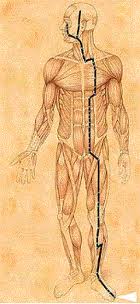
We haven't met an organ network this familiar to our collective unconscious since, well, the Large Intestine.  The resonance between the two of these unsubtle, materialistic organs is no accident, either; together the Stomach and L.I. make up a single hand-to-foot acupuncture channel called the Yang Ming meridian.  Yang Ming means 'bright Yang' or by extension 'bright sun,' and this meridian runs right down the frontmost part of the body.  It's where the sun do shine.  And think of this: the Stomach portion of the channel runs through or around all of the "sense doors"in the head (eyes, nose, mouth, ears), down the front through the nipples, down next to the genitals and the rest of the way down the anterior aspect of the legs.  It's as far forward as it could possibly be, and it takes in all of our sensory/pleasure centers.  It's no leap, then, to say the Stomach is the organ that draws us forward in the world.  This is the frequency of appetites of all kinds.  The Hexagram--number 43, Guai--even looks like a bucket that wants filling.


Nothing wrong with all this rushing and feeding.  We need strong instincts and appetites to keep us on top of the natural selection heap, or once did (now a little cash goes a long way).  But as with any of the organ frequencies, the trend of the Stomach can get out of control.  When the pursuit of sensory pleasures becomes the main purpose in life, the Stomach has usurped the imperial role of the Heart and put the gross (matter) above the subtle (spirit).  The Stomach's totem is the dragon, and it is the dragon's classic pathology to be greedy, hoarding material treasure.  Together with the Pericardium, then, the Stomach is the organ frequency most closely associated with addictions: the drive to get more of something that makes us feel good.  Neurologically, all addictions may be addictions to dopamine, the 'reward' chemical in our brains whose release our drugs (or activities) of choice stimulate.  Dopamine response is, on some level, a Stomach phenomenon.   This all is not to say that we should refrain from pleasures in general, or even that we should never let ourselves rush headlong into them.  But it's worth keeping in mind--and embodying--that the other half of the Stomach's rush is its ability to ruminate.  To chew on something for a long time; maybe even to follow the lead of our four-stomached friends and regurgitate it and chew some more.  After the rush comes the rest-and-digest.  A full belly allows us to move onto other, perhaps nobler pursuits.

Anyone who has ever fasted, even for a day, knows how much time there is all of a sudden when feeding falls off the agenda.  But this radical Stomach-centered therapy has its dangers: many of us are in need of firming up our connection to the material world, not weakening it.  Still, even simply skipping a meal once in a while can serve as a powerful reminder both that nourishment is precious and we are lucky to have such abundant access to it, and that there are other things were pursuing.

Back to the dragon: here we have a creature blessed with great strength, the gift of flight, and the ability to breathe fire.  A fierce fire-breather with a tender underbelly--what better symbol for the Stomach?  Although Chinese medicine does not refer to "digestive fire" the way Ayurveda does, the concept is implicit in the symbol of the dragon.  A healthy stomach means a healthy complement of fire, in the form of hydrochloric acid and digestive enzymes.  Of course we don't want this fire to come out; actually breathing fire is a sign of gastric distress.  But the ability to cook and transform what we take in is critical to digestive function.  The Stomach itself is responsible only for the first part--'cooking' and breaking down what we take in.  (The Spleen, as we shall see, takes over where the Stomach leaves off.)

Ayurveda may evocatively conceptualize the digestive process as one of fire--cooking and transforming--but Chinese thought takes another, equally interesting perspective.  The main digestive organs are classified as belonging mainly to the Earth element.  In the five element or five phase system, there are four directions with Earth in the center.  Earth is the stable point in the middle and so anchors the movement of the other elements.  As herbalist Paul Bergner points out, if we were plants, our roots would be the intestinal villi, and our digestive tract itself the soil out of which we grow.  Our food is our fertilizer, which these villi absorb.  Like Earth, nutrition is the very foundation of health.  Failure to digest well results in a variety of diseases, but one of the first signs of imbalance in the Earth element is what else but a feeling of ungroundedness.  When we lose our connection to Earth, "things fall apart, the center cannot hold," (thank you, Yeats) and our precarious embodied existence loses its foundation.

The theory's all well and good, but it's nice to have something to take home and chew on.  As an herb freak, I can't help but bring up ginger here.  Ginger is a simple but powerful medicine for the digestion: it somehow manages to be soothing and stimulating at the same time.  It calms nausea, relieves cramping, and generally tones the digestive fire, agni.  Of the two forms--fresh and dry--the dry stuff has a greater affinity for the Stomach (the fresh tends to go more towards the exterior of the body and cause sweating).  Perhaps because it can be drying, Chinese herbalism usually combines dry ginger with some licorice.  (Then again, Chinese herbalism combines almost everything with licorice.)  Ayurveda pulls a similar trick and often doles out pungent herbs with something sweet; perhaps the most convenient try-this-at-home approach is to use candied ginger.  Whatever form you use it in, though, ginger combines brings the fire back to the center and leaves the belly happy.


Credit: The bulk of this material was presented in the Chinese Cosmology course at NCNM that was originated by Heiner Fruehauf and taught this summer by Gregory Sax.  Thanks to them and my classmates for all the insights!