Showing posts with label Chinese medicine. Show all posts

Saturday, October 29, 2011

Wizard Training, a.k.a The School of Classical Chinese Medicine at NCNM

It's official.  I go to school at Hogwarts.

Brandt Stickley
Seriously.  Today I had my first broomstick lesson (though I've maintained unofficial witch status for a while now, according to Bobby the Rooster)--levitation is one possible outcome of Jin Jing style Qi Gong.  There's actually a potions class (Herbs Lab with Eric Grey).  And clinical observation with Brandt Stickley--who bears a superficial resemblance to a certain Professor Snape--might as well be called shamanic training.

Fittingly, we Classical Chinese Medicine wizards-to-be are surrounded by Muggles: NCNM's  naturopathic students, a bunch largely steeped in scientific materialism.  Whereas we CCMers largely eschew quantitative methods and aspire to the level of the "superior physician," one able to diagnose through pure intuition and a quick glance at the patient.  We are leg in this lofty goal by an often Dumbledorean cast of characters, each with his/her own wisdom to offer.  And naturally, few of our head mages sing the same tune, or even seem to speak the same language sometimes.  We don't quite have four separate sub-teams, as per Ravenclaw, Griffindor, etc., but already in the second year we seem to be breaking into partisans of this or that teacher: the clan of Givens, the Heinerian order, and so forth.  We are distinguished as well by area of interest: acupuncture, bodywork, herbs and...let's just say 'other.'  Hey, Hogwarts had its partisans of Madame whats-her-name's crystal ball scrying class, and we have our fringe element as well.  (Though, ironically enough, Chinese divination and the I Ching is a relatively mainstream and undisputed topic for us.)

A fully trained acupuncturist
As of yet we haven't had much contact with the forces of darkness; I haven't even heard much in the way ominous rumblings from the OHSU medical campus on its stern, indomitable hill.  We do take our lives into our hands every day when crossing the "chicken run" at the corner of SW Kelly and Corbett, though, and we brave the hazards of the neighborhood food desert--a desert only in comparison to the absurdly gourmet bounty that is the rest of central Portland.  Still, a time will surely come when we will arm ourselves with 34-gauge, 2 cun stainless steel needles, high-grade Japanese golden moxa, and bulk (never granulated!) herbs and make a stand against the legion of doom clammering at the gates.

Until such a day should arrive, we bide our time, memorizing the esoteric significance of ancient Chinese anatomy and learning to recognize the 25 herbs of the Tang Ye Jing by taste alone.  Muggles, take heed; one day the fully-trained denizens world you never imagined will materialize in your midst to dazzle you with seemingly impossible feats of pattern recognition and symbol interpretation.

Don't say you haven't been warned!

Tuesday, September 27, 2011

Drinking Straight From the Hydrant

The title phrase fairly well describes my experience of studying Chinese medicine at NCNM these days.  I'm by turns pummeled, exhilarated, soaked, and gorged on the high-velocity stream.  And when I pause for air, it's a little dismaying to see gallons of precious fluid spilling out into the street every second.  At least I can't complain of being dehydrated.

The preliminaries of the first year are out of the way and we're getting into the meat now: herbs, acu-moxa points, pathology, case studies, and clinical observation, in addition to such juicy morsels as immunology and clinical physical diagnosis.  Presenting this smorgasbord of material is a particularly brilliant array of faculty, each with a wildly individual style: Paul Kalnins' free-wheeling integration of biomedicine with the Chinese framework and Anthroposophical medicine; Brandt Stickley's penetrating psychological approach; David Berkshire's practical mix of TCM and Worsley Five Element, just to name a few.  It's enough to make me--usually ever thirsty for more--want to slow down, to take a breather to process and assimilate the wealth of information.  But every new day brings a different class with a different instructor and different set of expectations.  By the time a week goes by and the next session of any one class comes around again, there's been so much presented in the meantime that I'm twenty or thirty pages ahead in my all-in-one little spiral notebook.  By year's end I envision a stack of such raggedy things lining my bookshelves, which are already sagging from the weight of acupuncture and herbal tomes, a Chinese dictionary or two, ancient classics like the Nei Jing, three versions of the I Ching, and western herbals from Matthew Wood and Michael Moore...

Signs of my single-minded caduceal pursuit have in fact taken over my room completely: my big poster-sized Chinese organ clock is installed on the wall above the computer I'm typing on; next to the overstuffed bookshelf are arrayed three separate bookcases of tinctures and bulk herbs.  There's a small area reserved for sleeping, I'll admit, and a picture of some loved ones, two photo montages from my Southasian travels, and two hanging houseplants (whose medicinal properties I have not explored--yet).  There's a small dresser, and a mirror, and other such mundanery. But the overall impression is overwhelmingly of an herbalist's inner sanctum.  Things are going to get worse before they get better--and "better" only means the medicinary will outgrow my little room altogether and initiate a hostile takeover of the apartment at large.

Yes, I've finally done it: immersed myself completely and quite irrevocably in a world of my own obsessions. (Passions, to put it in more appropriately positive light.) It's not such a strange thing to do, really; in this place, at this time, it feels almost normal.  This ain't Kansas anymore.  Nor Manhattan.  No, this is the beginning of the future, and the future is the beginning of the end.  But let's not talk about that.  For the time being, I'm just thankful to be here in Portland, in 2011.  I mean, it may be the egocentrism of youth, but this place and time feels like what I imagine Greenwich Village felt like in the early sixties.  I refer not so much to Portland's bohemian side, though that is substantial, but to the bubble and ferment of creative energy that's evident all over the city.  The sense of being a bubble on the vanguard wave--part of an as yet undefined movement.  From my own vantage point amidst the rollicking motion, it's hard to see what the movement shares, besides ideals of simpler, more natural living, real food, self-expression, low-impact modes of transportation.  Maybe I need to watch Portlandia and get in better touch with the stereotype.  I think there's a deeper valuing of tradition--or a valuing of deeper traditions--than the hippie generation tended to exhibit.  This must have something to do with the sense of imminent planetary peril (a sense that, I admit, is nothing new), not to say doom, that's in the air.

Every time may very well be a pivotal one, but this really feels like the neck of the hourglass.  I'm not much interested in theories of 2012, but the mathematician in me senses the inflection point on the societal curve--that almost imperceptible moment when acceleration starts to slow down, when convex becomes concave.  Interesting times!


Monday, August 29, 2011

Chinese Organ Networks: Stomach


Agni, the Vedic god of fire.  Agnih Ayuh - fire is life.

If the twelve organ networks are 'frequencies' that we tune into like radio stations, the Stomach is our culture's Hot 97.  Is Hot 97 still around?  Am I dating myself hopelessly here?  In New York when I was growing up, at least, that particular vein of mainstream Hip-Hop and R & B was everywhere.  And the themes of most rap lyrics ("Ice Cream," anyone?) fit right into the Stomach paradigm: oftentimes they're about chasing sensory pleasures and material success.  About the rush forward to feast the senses.  The Stomach, in short, is about appetites.  

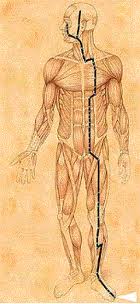
We haven't met an organ network this familiar to our collective unconscious since, well, the Large Intestine.  The resonance between the two of these unsubtle, materialistic organs is no accident, either; together the Stomach and L.I. make up a single hand-to-foot acupuncture channel called the Yang Ming meridian.  Yang Ming means 'bright Yang' or by extension 'bright sun,' and this meridian runs right down the frontmost part of the body.  It's where the sun do shine.  And think of this: the Stomach portion of the channel runs through or around all of the "sense doors"in the head (eyes, nose, mouth, ears), down the front through the nipples, down next to the genitals and the rest of the way down the anterior aspect of the legs.  It's as far forward as it could possibly be, and it takes in all of our sensory/pleasure centers.  It's no leap, then, to say the Stomach is the organ that draws us forward in the world.  This is the frequency of appetites of all kinds.  The Hexagram--number 43, Guai--even looks like a bucket that wants filling.


Nothing wrong with all this rushing and feeding.  We need strong instincts and appetites to keep us on top of the natural selection heap, or once did (now a little cash goes a long way).  But as with any of the organ frequencies, the trend of the Stomach can get out of control.  When the pursuit of sensory pleasures becomes the main purpose in life, the Stomach has usurped the imperial role of the Heart and put the gross (matter) above the subtle (spirit).  The Stomach's totem is the dragon, and it is the dragon's classic pathology to be greedy, hoarding material treasure.  Together with the Pericardium, then, the Stomach is the organ frequency most closely associated with addictions: the drive to get more of something that makes us feel good.  Neurologically, all addictions may be addictions to dopamine, the 'reward' chemical in our brains whose release our drugs (or activities) of choice stimulate.  Dopamine response is, on some level, a Stomach phenomenon.   This all is not to say that we should refrain from pleasures in general, or even that we should never let ourselves rush headlong into them.  But it's worth keeping in mind--and embodying--that the other half of the Stomach's rush is its ability to ruminate.  To chew on something for a long time; maybe even to follow the lead of our four-stomached friends and regurgitate it and chew some more.  After the rush comes the rest-and-digest.  A full belly allows us to move onto other, perhaps nobler pursuits.

Anyone who has ever fasted, even for a day, knows how much time there is all of a sudden when feeding falls off the agenda.  But this radical Stomach-centered therapy has its dangers: many of us are in need of firming up our connection to the material world, not weakening it.  Still, even simply skipping a meal once in a while can serve as a powerful reminder both that nourishment is precious and we are lucky to have such abundant access to it, and that there are other things were pursuing.

Back to the dragon: here we have a creature blessed with great strength, the gift of flight, and the ability to breathe fire.  A fierce fire-breather with a tender underbelly--what better symbol for the Stomach?  Although Chinese medicine does not refer to "digestive fire" the way Ayurveda does, the concept is implicit in the symbol of the dragon.  A healthy stomach means a healthy complement of fire, in the form of hydrochloric acid and digestive enzymes.  Of course we don't want this fire to come out; actually breathing fire is a sign of gastric distress.  But the ability to cook and transform what we take in is critical to digestive function.  The Stomach itself is responsible only for the first part--'cooking' and breaking down what we take in.  (The Spleen, as we shall see, takes over where the Stomach leaves off.)

Ayurveda may evocatively conceptualize the digestive process as one of fire--cooking and transforming--but Chinese thought takes another, equally interesting perspective.  The main digestive organs are classified as belonging mainly to the Earth element.  In the five element or five phase system, there are four directions with Earth in the center.  Earth is the stable point in the middle and so anchors the movement of the other elements.  As herbalist Paul Bergner points out, if we were plants, our roots would be the intestinal villi, and our digestive tract itself the soil out of which we grow.  Our food is our fertilizer, which these villi absorb.  Like Earth, nutrition is the very foundation of health.  Failure to digest well results in a variety of diseases, but one of the first signs of imbalance in the Earth element is what else but a feeling of ungroundedness.  When we lose our connection to Earth, "things fall apart, the center cannot hold," (thank you, Yeats) and our precarious embodied existence loses its foundation.

The theory's all well and good, but it's nice to have something to take home and chew on.  As an herb freak, I can't help but bring up ginger here.  Ginger is a simple but powerful medicine for the digestion: it somehow manages to be soothing and stimulating at the same time.  It calms nausea, relieves cramping, and generally tones the digestive fire, agni.  Of the two forms--fresh and dry--the dry stuff has a greater affinity for the Stomach (the fresh tends to go more towards the exterior of the body and cause sweating).  Perhaps because it can be drying, Chinese herbalism usually combines dry ginger with some licorice.  (Then again, Chinese herbalism combines almost everything with licorice.)  Ayurveda pulls a similar trick and often doles out pungent herbs with something sweet; perhaps the most convenient try-this-at-home approach is to use candied ginger.  Whatever form you use it in, though, ginger combines brings the fire back to the center and leaves the belly happy.


Credit: The bulk of this material was presented in the Chinese Cosmology course at NCNM that was originated by Heiner Fruehauf and taught this summer by Gregory Sax.  Thanks to them and my classmates for all the insights!


Wednesday, June 22, 2011

Chinese Organ Networks: Liver

And so we come around to the Liver.  The Liver is a frickin' doozy.  Enough so that I'm actually procrastinating jumping into the meat of the matter, because I hardly know where to start.  This is an organ system rife with rich associations and layers of meaning that seem to shoot out in all directions like fresh green tendrils in springtime.  Stubbornly spreading up and out, against gravity, persevering against tough odds--namely the laws of physics, which luckily seem not to apply to living things.  Or rather, life finds the loopholes and bends said laws to its own benefit and makes of Newton and Descartes a gleeful mock.
                                                                          ^An ancient Etruscan bronze liver, probably used for divination instruction and practice

As usual, the macrocosmic position of the organ reveals much of its nature.  We saw how in a sense the Gallbladder marks the beginning of the new year, as yang (light, warmth) makes its return--as yet unfelt, perhaps, but influential all the same.  To the Liver falls the task of continuing the what the Gallbladder has initiated.  The Gallbladder's job was romantic--the spark in the dark, setting things off with a little explosion; the Liver's is decidedly less so.  The Liver doesn't take that critical first step back towards the light, but rather the equally critical second step.  It plods forward, against the flow, against gravity.  It perseveres.  Its animal symbol is the ox: the creature best suited to long, hard labor.  The ox wants and needs something to push against.

Labor...pushing...if this is all sounding suspiciously feminine, it's not a coincidence.  The Liver is the organ most closely associated with womanhood, most obviously through the blood, which the Liver is said to store.  "Women are blood, men are qi," goes a Chinese medicine saying.  But we are getting ahead of ourselves.  We aren't finished with the ox.  Could there be a more specific connection between oxen and women?  Here's a hint: take a look at a picture of an ox head or skull.  Georgia' O'Keeffe was on top of this one (though she chose a ram, the effect is much the same.)  The relation of head and horns is strikingly similar to that of womb and ovaries via the Fallopian tubes.  Women, in some sense, have the power of oxen: to push, to persevere, to plod forward and continue the endless work.  Masculine energy is more apt to come in bursts; men are often good initiators and warriors, hunters, whereas women keep the ball rolling.  Hormonally, women may be better suited to traditional "women's work"--not just the obvious maternal activities but such slow, methodical, careful work as weaving, spinning, seed-sorting, knitting.  It's not just a matter of culture.  Women are rich in blood, which in Chinese medicine also means certain hormones, and this hormonal reality shapes much of physical, psychological reality.

Of course it's not just women who benefit from the ability to push, to go against the flow.  This type of sustained work is at the heart of self-cultivation practices, from martial arts to meditation and everything in between (Tai Qi and Qi Gong and genuine Hatha Yoga tend to fall towards the center of this spectrum).  The Chinese sagely ideal is of wu wei, effortless action; but in order to achieve such a state of skill it is necessary to train intensively.  The archetypal Zen master who flows so artfully through life does not achieve their mastery except through rigorous training.

There's yet another feminine connection to be made.  The Liver's cosmological time is most of January and the beginning of February, a period which overlaps (even if it doesn't completely correspond) with the Western astrological sign of Aquarius.  At first glance the associations are disparate; the Liver with blood and femininity and Aquarius with water, creativity, prophetic change.  Symbols take us deeper, however.  The traditional shorthand for Aquarius is a double squiggle, like two letter M's nested on top of one another.  Now it is an interesting fact that the word for "mother" in virtually every language begins with or contains the "m" sound.  mother, mama, mom, mu, ma, aama, maman...there are probably exceptions, but I can't come up with any.  Infants seem hardwired to make the "m" sound in relation to their mothers.  The letter M even look like a couple of a pair of bent legs, spread, as in a reclining birthing position.  Aquarius is also classified as an air sign; we'll soon see how air or wind relates to the Liver.


That's two liver-blood-femininity strings of association so far.  We've momentarily come up for air; time now to dive down and pull up one more set.  The Liver stores the blood, has everything to do with this vital substance.  What is the blood, on the level of micro-macrocosmic correspondences?  It is our vital water, our veins and arteries like rivulets and streams and great rivers.  They all flow into the sea, our great reservoir of blood, the Liver.  Another way to look at it: evolutionarily we come from the ocean.  Primitive sea creatures need no closed circulatory systems, but when we crawled out of the watery depths, we needed a way to bring some of that ocean with us.  The blood, and especially the Liver's blood reservoir, is that oceanic remnant.  It's noteworthy, too, that we're not talking about fresh water here.  The ocean is salty, and so is the blood.  Nor is the saltiness of either composed of simple sodium chloride, though that is the most prominent component of ocean and blood salts by weight.  The ocean contains hundreds of trace minerals in solution, and so does our blood.  Though nutritional science hasn't uncovered a physiological need for every such mineral, more and more are being found to be essential to health.  This is why unrefined sea salt (including salt mined from ancient sea beds) are so critical to health.  Remove all those essential trace minerals, and you compromise the quality of your internal ocean.

Another conceptual leap: the Liver and blood relate directly to Wind and the nervous system.  The most basic connection is to be found in the trigram Xun, The Gentle or Wind or The Subtle.  It shows a single yin line penetrating up through two steadfast yang lines.  It is yin moving upwards, and represents the pervasiveness of subtle influence.  This is how a breeze operates: it is gentle, but if it maintains a consistent direction it can be powerful in the long run.  But Xun is also a symbol for Wood, the upward growth of springtime.  It is the yin aspect of Wood, just as the Liver is the yin Wood organ (and the Gallbladder yang Wood, as represented by the trigram Zhen, with one yang line thrusting up below two of yin).  Wind, the force of movement and communication, is related to springtime.  Spring is, after all, the time when things are shaken up, when the "winds of change" blow.  That, roughly, is how the physiological force of Wind or Air is related to the Liver.  (An interesting contrast with Ayurveda here; in that system, Wind or Vata is more associated with the large intestine, and while it is closely related to the nervous system, the concept of blood and the liver is largely separate.  At least as far as I understand it.)

So the Liver is responsible for Wind, for proper movement.  Movement of what?  Of qi, primarily.  Of subtle energy, including perhaps the electro-chemical impulses that are the language of our nervous system.  Now it may be less surprising that trace mineral deficiencies have been implicated in a number of growing disorders including ADD and ADHD.  These can be viewed in terms of Wind; hypermobility; an ungrounded and in some sense overactive nervous system.  When our blood is not well fortified with the natural ocean's mineral spectrum, our Wood and with it our Wind go out of whack.  In our terms, its a Liver problem.

We've yet to look at the Confucian 12 officials system.  In it the role of the Liver is clear cut: it is the general.  It commands, strategizes, schemes.  Physiologically, the little-L liver sorts out thousands or millions of chemical reaction pathways, sending this here and that there and generally ironing out an operating plan for the Gallbladder to execute.  The Liver is resourceful.  As a commander it wants to win; it strives to live.  See?  It's not just the Chinese language that contains plenty of forgotten symbolic resonance.  The liver is the only organ that is capable of fully regenerating itself from a small fraction.  It's that (re)generative power of Wood.

Finally, the herbal side of the story.  The herb that best represents the upward and outward exuberance of Wood is none other than the familiar cinnamon (Chinese Gui Zhi (twigs) or Rou Gui (bark)).  Cinnamon was anciently classified in the Tang Ye Jing as a "Wood within Wood" herb, meaning that it is the essence of Wood.  Although modern TCM likes to treat the liver in terms of suppressing flaring liver yang with cold herbs and smoothing out the liver qi with herbs like Bupleurum (Chai Hu), much modern Liver pathology has more to do with cold in the blood.  Here our internal ocean gets frozen over, leading to blood deficiency and stasis, with signs like cold extremities, menstrual cramps with clotty bleeding, and sexual frigidity.  Bulldozing through the ice with qi-moving herbs won't work; we have to melt the ice.  Cinnamon gets into the blood layer (Jue Yin) and does just that, especially when combined with the star blood herb Dang Gui (Chinese Angelica).

Sources: as always with the Chinese Organ Networks series, virtually all the material for this post comes from Dr. Heiner's Fruehauf's Chinese Cosmology lectures at NCNM.  Hail the chief!


Tuesday, May 10, 2011

Chinese Organ Networks: Triple Warmer


While living in Kathmandu, I would get a cold almost every month.  Normally I get a sniffle once or twice a year and figured it was the ever-present smog of Nepal’s fast expanding capital that made the difference.  Of course, the heavy, hazy air didn’t exactly encourage me to get outside much for exercise, so I had that working against me as well.  Eventually I noticed a third factor that seemed to be the decisive one.  I lived near a popular ex-pat restaurant that served some of the city’s more palatable pizza.  When I got tired of the ubiquitous daal-bhaat (rice and soupy lentils with just enough vegetables and chutneys to lend each hand-scooped mouthful some flavor) I would sometimes treat myself at the pizza place (the Roadhouse Cafe in Bhatbhateni).  What struck me after a few months was that my head colds would come on reliably the day after the pizza.  This shouldn’t have come as a huge surprise, given that I was in Nepal to study Ayurvedic medicine, and it is elementary in Ayurveda that cheese is a phlegm-forming, kapha sort of food that will tend to cause colds, cough, and congestion.  This knowledge may have slowed me down, but it didn’t stop me; I ate at the roadhouse quite a few times over the course of my tenure in Nepal, and while I didn’t get sick every time, it happened at least once or twice more.  (I did at least get smarter about it make sure to antidote the yak cheese with plenty of black pepper and other pungent digestives).  
What this little anecdote points to, besides the minor perils of ex-pat living, is the role of the lymph in immunity.  The lymph ducts form a sort of subterranean waterway that parallels the more familiar blood vessels, shadowing them through the streets and avenues of our bodies like a network of sewer tunnels.  Their job is to transport fats and oils (which are absorbed through a different mechanism from protein and carbs) as well as the white blood cells that constitute the various branches of our immune army.  Unlike blood vessels, they don’t have a heart to pump their contents along, but rely on the movement of our bodies to keep them from stagnating.  My little Kathmandu vignette is a perfect example of how to gum up the lymph: not much exercise, immune burden from environmental toxins, and then the kicker, a sudden load of fat.  When my lymph vessels filled with sticky cheese metabolites, the already under-siege immune cells got stuck in the muck.  The resulting colds can be seen not just as viral issue due in part to low immunity but also as the body’s way of clearing out the excess kapha--the dense, damp, phlegmatic humor--by melting it.  The fact that I felt like the dead for a couple days was a small price for my system to pay for clearing out the traffic jam in the immune highway system.  
And now for the ever-so-smooth transition to Chinese Medicine...
Like sewers, the lymphatic ducts work best when they’re empty.  The Daoist tradition is well aware of the value of this kind of emptiness: what else makes a cup useful, or a room?  This kind of strategic emptiness allows for another quality that is closely associated with the Dao: flow.  If we stay unimpeded, keeping our vessels empty, we make room for flow to happen.  Here philosophy and its sister, medicine, are imitating nature; those in pursuit of flow or Dao (“the way”) have long looked to water as a model.  Water is that whose movement is effortless--always flowing by the path of least resistance--and completely efficient; moving water is focused, relentless, and ultimately able to overpower harder substances such as rock.  Water embodies wu wei, the Daoist ideal of non-action.  According to this teaching, the highest form of action comes from a still place of masterful non-effort.  Wu wei is exhibited by the martial artist who turns an opponent’s attack against him and sends him flying with a barely perceptible motion, or an athlete “in the zone” whose every movement becomes fluid, instinctual, and highly effective.  Being “in the zone” means being in the flow of things, in other words, being like water.  
All this watery talk so far, and still no mention of any Chinese organ!  I have, I admit, been putting off introducing the unlikely-sounding Triple Warmer (or Triple Heater, or Three Burners), it being an “organ” that requires some explanation.  Unlike the Spleen, the Bladder, or even the Pericardium, the Triple Warmer has no clear anatomical correlate.  Its name refers to the three” “burning spaces” in the body, the zones of metabolic fire that causes our bodily water to circulate.  This probably isn’t a bad way to sum up the Triple Warmer’s function: the fire in the water.  Some more on the water half of this equation, before we delve into the more firey side.  
Another remarkable quality of water is that it connects things.  We even define geographic areas in terms of their watersheds, a watershed being that area which is drained by a given river system.  In theory, every drop of water that falls in a particular watershed ends up in the associated river.  Seen more organically, the river with its branching tributaries reaches out to every bit of land around it, so that no patch of ground is far from a stream or rivulet.  In the body, we see the arteries branching smaller and smaller in capillaries, until every cell is within spitting distance of life-giving blood supply (lymph works in a similar way).  Water is that which connects things, binds them together; there’s no separating my water from your water, which is why the tribe downstream from the river-crappers goes to war every time.  If the Triple Warmer has everything to do with flow in the system and with connection, we have good reason to look to beyond the lymph to the nervous system and, even more etherically, the endocrine system.  These de-centralized networks govern the communication and the flow of information, through electrochemical impulses and hormones, respectively; they affect everything that impacts our other systems and affects them back in turn.  
Before I lose you or get lost myself in a thicket of anatomical jargon, let me return to the thread.  By way--naturally--of a digression.  Our last organ system was the Pericardium, which corresponded to the autumnal equinox, when the darkness overpowers the light.  With this shift we are now in the dark half of the yearly cycle, the realm of yin.  And although the Triple Warmer’s month (the 10th month of the Chinese lunar calendar, if you’re counting) is not yet at the darkest time of year, it can be said to be the most yin month of all.  It is the time when nature dies back, life returns into the earth to rest.  It is the stillest hour of night, before even the faintest stirrings of dawn.  The next month will be even darker, deeper into the winter and the night, and yet it is that darkest month that contains the seed of light.  On December 22nd, the light is already returning, and on Christmas we unknowing pagans still celebrate this return with candles and feasting.  But here in Triple Warmer time we aren’t yet there.  Accordingly, the Yi Jing (I Ching) ‘tidal’ hexagram for this month consists of all yin lines.  This fits in very well with all our talk of wateriness.  Yin yields, is dark and cool, like water.  Finally, now, we’re ready to bring fire into the fold.  For just as extreme yin contains the seed of yang at winter solstice, we can see stillness as the greatest strength.  It’s wu wei again.  In vigorous movement, energy is active, at the surface.  Usually, too, it’s in the process of being spent: we speak of burning calories, and burning is exactly what we’re doing.  (The other side of this is that we’re burning something, and that ‘something’ may not be as replaceable as we tend to assume).  In stillness, on the other hand, that same energy is latent.  In this view, darkness is simply hiding light, or the potential for light.  A store of concentrated fuel.  If this sounds awfully familiar, it may be because this was the focus of the Kidney article a couple of months ago: the Kidney as battery.  The Triple Warmer overlaps with the Kidney here as an organ responsible for husbanding bodily reserve fuel and parceling it out as appropriate.  
Late to make her entrance, our representative animal this time is the pig.  The humble pig, so intelligent and clean--or is it dumb and dirty?  So...naked.  So oddly human-like; our bodies will often accept pig parts in transplants.  And, above all, so good at doing so little.  The pig is a symbol of wu wei: doing so little, and doing it so well.  Out of this porcine lassitude comes tremendous abundance: litter after litter of chubby little squealers, while the mama sow herself grows hugely fat.  This is perhaps the greatest talent of pig-kind: they make fat from almost anything.  In a world where fat was not so abundant as it is now (at least to the privileged classes, including more and more Chinese, with their prodigious appetite for pork), this ability must have seemed to verge on the miraculous.  It helps explain the pig’s status in China as a symbol of prosperity and plenty.  In this light, the following tidbit from the 16th Century herbal compilation Ben Cao Gang Mu may make more sense: “for skinniness disease...the fat of the pig’s kidneys.”  The fat of the kidneys is nothing other than leaf lard, which until the ill-omened dawn of the Crisco era was the preferred fat for making pastry here in America.  This fat from around the pig’s kidneys surely contains the adrenal gland itself; when we have leaf-lard pie crust, we are feasting on an aspect of the wu wei organ of the wu wei animal.  Provided that the pigs in question are allowed to do nothing in their inimitable way, outdoors, wallowing and rooting and doing that nothing that pigs love to do.  Factory pig fat doesn't have the magic.  So slow down, get in the flow--and get to baking with yon leaf lard.  Your Triple Warmer will thank you.  

Sunday, April 24, 2011

Chinese Organ Networks: Pericardium


The twelve organs of Chinese medicine are a way of dividing the world--the world as seen through human eyes--into twelve sections.  Everything in the world, then, falls into one of these sections, just as every cherry in a pie will end up in one slice or another, unless of course it gets cut in half and ends up straddling two slices.  That happens with the organs, too--in fact many phenomena have multiple organ affinities--but we'll leave aside such complications for now.  The point is that the twelve organs are a convenient and powerful lens through which to view things, and not least medical things.  We already have a two-fold division (yin and yang, night and day, male and female, etc.) and a three-fold one (heavenly, human, and earthly realms), a five-fold one (the 5 "phase elements" of wood, fire, earth, metal, water), and even a six-fold one (the six levels or conformations).  Each of these lenses has its utility; with the leap up to twelve, we have the most specific, fine-grained lens of all.  It encompasses all of the levels before it, for each organ is associated with yin or yang, with one of the three realms, with a phase element (or multiple elements, if we look closer), and with a conformation.  Twelve allow for complexity without going off the deep end.

Yet despite the universal appeal of the number twelve, early Chinese medical texts speak of the "five zang (solid organs) and six fu (hollow organs)."  The focus of this article, the Pericardium, was conspicuously absent from this picture.  And indeed, if you had to choose 11 or 12 organs to represent the entirety of the human universe, the membranous sac around that surrounds the heart would not likely be one of them.  There are so many...more substantial structures to choose.  So it's fair to ask: what's the deal with the Pericardium?

Actually its status as the added-on organ is key to its nature.  The Pericardium was brought into the picture, in a sense, to keep the lonely sixth fu organ company.  This is a clue to what the Pericardium is all about: relationship, intimacy, vulnerability.  Qi Gong teacher Bill Frazier explains the late arrival of the Pericardium in another way: this "heart protector" (a common translation of the PC) only became necessary when humans began living in such dense proximity that we no longer knew all our neighbors. When we lost the deep communal connection synonymous with tribal or small-scale pastoral living, we began to need to guard ourselves in a new way.  Suddenly it was dangerous to share our innermost selves; amongst strangers who knows who might take advantage of such open-heartedness?  In this little myth, along came the Pericardium to guard the gates of the Heart.

It's not hard to recognize the necessity of a Heart Protector, a body guard or watchdog to mind the Heart-emperor, who's too busy tuning in to the heavenly mandate to look after his or her own damn self.  But in modern Traditional Chinese Medicine, this guardian role of the PC may be over-emphasized.  The flip side of the Pericardium's role is to open the Heart, like the dog who allows trusted people entry to meet his master.  We all need protection, safety, security, but too much of these things cuts us off from other people, from potential fellowship and communion.  We need walls around our Hearts, but we also need gates that can open.  The Pericardium is this gate, and it might just as well be called the Heart Opener.

On the calendrical scale, the PC is associated with post-equinox autumn, and in the context of the day, with the post-sunset hours or approximately 7-9 PM.  These are times of darkness overpowering light, of inward-turning.  And also of intimacy.  As Heiner Fruehauf, my source for virtually all of this cosmology, points out, who goes out on a romantic lunch date?  The dinner hour is the intimate one, the one charged with romantic potential.  Looking at the larger yearly cycle, it may be less obvious how the dark, chilly month of (roughly) November carries such sexy connotations.  It is, no doubt, also a season of death: nature dies back, and following her lead, humans course through the woods to hunt.  Yet this was once the traditional wedding season in China.  It is after all the time when the leaves fall: the forests are undressing to reveal the mountains, the bare breasts of nature.

It will come as no surprise, then, that the anatomy most closely associated with the Pericardium is this region of the chest.  One Chinese name for the Pericardium is Xin Bao, "heart wrapper;" another is Dan Zhong, "chest center."  The quintessential pericardium point is, more specifically, the midpoint between the nipples.  This is a vulnerable area of the body, no doubt, and an intimate one.  To whom do we bare our chests, our breasts?  Well, to a lot of people, maybe.  But out culture's schizophrenic relationship to nudity and sex can be seen as symptomatic of a larger Pericardium pathology.

As discussed, the Pericardium controls how open our hearts are at any given time.  In love, the Pericardium relaxes and dilates, we let our guard down, and are able to share ourselves completely with another person.  Part of the potential of love is to take this openness out to the world; to come from a place of safety in vulnerability and expand outwards to face everyone and everything in our lives with open hearts.  Of course there is the risk that when our open hearts are betrayed or wounded, the Pericardium sits bolt upright like a bodyguard that had been snoozing and battens down the hatches.  We shut down emotionally, put up barriers, simultaneously protecting ourselves and cutting ourselves off.  Back now to modern PC pathology: though we need to open and close our hearts appropriately, most people are stuck too far to one end of the spectrum.  There are those who, through trauma, have their Pericardia on permanent lock-down mode--scared, nervous guard-dogs who don't recognize friends.  Though it's rarer, some people fall into the opposite category: they are too open-hearted, have trouble delineating boundaries for themselves, and get into trouble because of it.  Perhaps more common than this is the confused Pericardium: we may be too open on the outside and shut down or exhausted within.  A healthier model might be the reverse of this: a reserved, moderate exterior containing a passionate heart.

This whole time our model for the Pericardium has been the dog: guardian, yes, but also faithful companion, playful puppy, tireless servant.  In fine symbolic fashion, the best and worst of the Pericardium are summed up here.  Our source of joy, innocence, and playfulness can also translate to a lack of seriousness, as in a puppy who only wants to have fun.  The antidote to this, perhaps, is the training that turns a pup into a mature, loyal and selfless companion.  Represented here is the channeling of heart energy towards away from simple pursuit of pleasure and towards a higher calling; the act of sacrifice.

(<-- Not a puppy, I realize, but an equally heart-opening furry thing)

Tuesday, March 22, 2011

Double Whammy! Yin Yang Theory and the Chinese Heart


OK, I'll admit right off the bat that this post involves some pretty heavy recycling of school assignments.  But then, what I write for school and what I write outside of it (or would given the time) are tending to converge.  I take this as a good sign.  
Without further ado then, here are a couple of short pieces on foundational aspects of Chinese medicine.  Oh, and I should say that the second piece owes a great deal to Dr. Heiner Fruehauf, whose life's work has centered around excavating and reviving the classical Chinese medical cosmology in all its glory.  

On Yin and Yang

Yin and Yang represent opposites--cold and hot, dark and bright, moist and dry, female and male, water and fire--and yet they are not opposing forces per se.  As with the sexes, they only make sense in terms of each other.  The Book of Genesis notwithstanding, would we be talking about ‘male’ if they weren’t a contrasting category, ‘female?’  Without cold we know no hot; light exists only in contrast to darkness.  These pairs are poles, defining a world between them.
 The characters for yin and yang contain the radical for ‘hill,’ so that Yin is the shady and Yang the sunny side of the same hill.  And clearly, the idea of a one-sided hill is absurd.  Yin and Yang define each other, need each other, and--more than this--they create each other, as the night births the day and the day the night, onwards in the eternal cycle of expansion and contraction.  The seasons and their five phases are a precise elaboration of this process, and everything in nature reflects reflects Yin and Yang through its organoleptic qualities.  New shoots in springtime are charged with yang emerging from the watery, yin stillness of winter.  Taproots gather and store yin, preparing for a future growth cycle (yang).  Bright colors, pungent taste, spikes--these outward, unsubtle qualities smack of the force of yang; softness, sweetness or blandness, downy leaves are all manifestations of yin.  As the Dao De Jing Chapter 39 tells us, “the humble is the root of the noble/the low is the foundation of the high.”  And lest the high should become proud, it must recall that it will lower itself again in time.  The tallest stone guard tower eventually becomes sand for children to shape into castles of their own, for the tide to fold into its embrace, for oysters to coat with pearly layers.  Pearls to royal necklaces, to be interred and dissolved back into the soil.    

On the Nature of Traditional Medicine: The Example of the Heart

We may argue over whether it is more of an art or a science, but medicine is certainly not a subject that stands in isolation.  Rather, a given culture’s medicine is a reflection of that culture’s ontology--their (often implicit) assumptions about the nature of reality--and their epistemology--their ideas about what constitutes knowledge and how that knowledge can be gleaned.  While modern biomedicine may claim for itself the status of “objective,” it is subject to all the limitations of its parent sciences of biology, chemistry, physics, etc., most notably their reductionist and materialist biases.  Actually, as modern medicine is an applied as opposed to a pure science, it tends to lag behind the scientific cutting edge by a generation or more, so that even events as distant as the quantum mechanical and relativistic revolution in physics in the early 20th Century have still not been thoroughly absorbed into the medical fold.  Rather, most of modern medicine operates on Newtonian assumptions about the nature of matter and its “laws.”  
The various strands of Chinese medicine no more stand alone than do their modern, biomedical counterparts.  In the worldview of ancient China, medicine was on a continuum with philosophy, part of an intellectual-spiritual complex that also includes astrology, feng shui, and the harmonizing, meaning-fixing practices that we tend to separate out from the rest of life and label “religion.”  This is to say that, as in most traditional cultures, there was in classical China no firm division between religion and philosophy, art and science, or science and religion.  All these disciplines, if it even makes sense to speak of them as distinct entities, shared a common cosmological understanding and used a symbolic language based in a system of associations or resonances linking microcosm and macrocosm.  In this system, the world bounded by the human skin is as a reflection of the world outside of it.  Humanity is not so much a part of nature as she is a distillation or crystallization of the universe, as in Blake’s “world in a grain of sand.”  Thus our organs each correspond to a network of constellations (the celestial level) and features of China’s geography (the terrestrial level) as well as to specific animals, sounds, and a whole host of other elements of reality as the ancients experienced it.  Every aspect of the medicine is informed by this rich network of correspondences and by the metaphorical language it gives rise to; nothing is merely what we measure it to be but rather an information-dense chunk of the universe whose nature can be inferred from its qualities and characteristics.  
                                         (Another metaphor for the heart ? >>)

To take an example, the Chinese conception of the heart includes all of 
these layers of context and resonant associations.   To begin with, a Chinese classical text states that “the heart is the human heart.”  We are dealing, then, with the organ that separates us from the beasts, that provides a home for our shen (spirit, consciousness).  The heart, as a zang or solid organ, is indeed an organ of storage, and as such is represented by a vessel.  However, he heart stores the immaterial spirit and not any physical substance; indeed, filling our hearts with material things gives rise to a pathological condition in which there is no room left for what matters.  So the heart is represented by an upside down vessel (as depicted in its I Ching hexagram).  This design for our innermost, essential organ allows it to shun what is material and fill up with immaterial shen as with a gas.  It is this shen that shines forth from its seat in the heart, radiating out in the face, with the light of consciousness.  This is the heart as life’s lamp.  The association of heart and face makes sense to us; we instinctively judge the state of someone’s spirit (or simply mood) based on what we see in their face.

As a complex composite formed over millennia, Chinese medicine includes layers of influences from different traditions, notably Daoism and Confucianism.  Daoism provides the esoteric and shamanistic parts; Confucianism lends it a pragmatically social dimension.  In the medicine, Confucianism is perhaps most visible in the theory of the 12 ministers.  Each organ is conceptualized as having a role in the government (the phrase "body politic" seems especially apt).  The heart, as will come as no surprise, is the emperor.  But unlike worldly emperors who seek power and prestige, the heart is the perfect spiritual leader, the one responsible for receiving the Mandate of Heaven.  The emperor, in classical China, is just such a one who the divine and human realms.  S/he need not actually do very much in the world, besides providing this all-important orientation and setting the example.  So with the heart.  If the heart is strong, the person's mission will be clear, and the other organs will naturally settle into their own, more worldly roles.  In case of a weak heart--and though we are talking about the Chinese heart, this also includes the physical organ--the other ministers may try and usurp its function.  The stomach, which mirrors the heart in certain respects, often attempts this, with the result that the affected person will follow his appetite around blindly and seek only to fill the vessel with the savors of material life.  
The heart’s elemental association is with fire.  In Chinese cosmology, the five phases or elements are not conceived of as substances per se, but rather as stages of a continuously-unfolding process.  They relate directly to the seasons of the year.  Briefly, water relates to winter, the time of inwardness and storage.  Wood, the energy of new growth springing forth, follows water and bursts forth out of its stillness with the advent of springtime.  Wood, new yang rising, matures into fire, the stage of flourishing and maturity.  Fire’s time is midsummer, when the world is alive with color and heat and the yang has reached its full manifestation.  At just this moment (summer solstice), as yang climaxes, there begins the return of the yin; the days start to get imperceptibly shorter.  Now is the time of the earth phase, when (in the climate of Northern China, at least, as in New England) nature seems to hang still for a moment and the golden perfection of late summer reigns.  In addition to this late summer time of stillness and peace, Earth also represents the center, if each other element is associated with a cardinal direction, and the transitional time between the seasons.  Finally, the year’s expansion collects and condenses back inward in the autumn.  This is the time of the metal phase, the harvest, the time of reaping what is valuable and letting the rest go.  Metal’s purity and sharpness is well represented by the crisp, clear, brilliant days of fall.  Metal, new yin, matures into water, yin at its fullest, and we are back in the realm of winter.  

But here, with the heart, we are in the fire phase.  Even more key here than the flourishing of yang is the idea of the return of yin: at the peak of outward expression the seeds of an inward turning germinate.  The heart, in all its sacred firyness, is just as much about forsaking the upward climb and looking in, down, towards the source.  In terms of the day it is high noon, the point when the long descent to nightfall begins though much light and warmth remain.  
The animal associated with the heart is the horse: noble, beautiful, powerful and graceful; yet proud, needing to be controlled, dangerous.  The message implicit here is that we must master the horses of our hearts, to direct them and not be run around by our desires and ego.  At its best, the horse is a symbol of sacrifice, as in mythical horses who ride themselves to death for their masters.  In Chinese myth, the perfect picture of the heart is the horse so devoted that she gallops until she sweats blood: the very fluid of the heart oozing from her pores.  
The symbolism of this organ, one of twelve in the Chinese system, spreads deep and wide.  There are meaningful associations with the geography of ancient China, with I Ching hexagrams and stellar constellation, as well as a great deal of medical theory.  But it is in the nature of this kind of holographic system that every part contains the whole, so that the simple image of an empty earthen vessel shining like a lamp, of a blood-sweating horse, or of the moment of summer solstice convey the meaning of the organ.

Sunday, February 6, 2011

Springtime Stirrings

It's been a long time, here at your random word generation device--over a month, I guess--and I apologize.  I try not to let more than two or three weeks go by between posts.  But I been busy with moving in, adjusting to school life, and getting my head and belly fully into the game of my studies in Chinese medicine and traditional Western herbalism.  I'm a month into my four year program in the former, and about to start a 9-month long course in the latter at the School of Traditional Western Herbalism with renowned herbalist Matthew Wood and some bad-ass local teachers to boot.  I'm probably slightly insane to be taking all of it on at once, but I'm awful thirsty.  More on the herbal stuff later, as it gets rolling.  Today (in honor of the advent of the Year of the Rabbit, perhaps?) I want to focus on the Chinese end of things.

Underlying the bustle of a busy new school schedule and tying together my seemingly disparate set of classes at the Classical Chinese Medicine program at NCNM is the real work: becoming intimately familiar with the conceptual framework of pre-modern China.  I may be spending a lot of time learning Chinese characters, probing auricular acupoints and practicing pulse and tongue diagnosis, but the fundamental task of this first year is getting grounded in another worldview.  This process involves a certain amount of culture shock, as when the "organs" of Chinese medicine turn out not to correspond too terribly closely to their anatomical namesakes, or even to anatomy at all.  In the CCM program luminary Dr. Heiner Fruehauf's cosmology course, we explore the esoteric resonances of each of the 12 "organ networks" one at a time, spending weeks on each one as we examine the hidden layers of depth that will ultimately serve to unlock the medical system but that modern "traditional Chinese medicine" (TCM) too often misses completely in its drive to root itself in modern scientific objectivity.  Thus TCM usually dismisses the association of the Lung (capitalization indicating that it is the Chinese organ in question) with the Tiger as mere superstition, when in fact this connection is one of the keys to understanding the function of the Lung both in terms of healthy function and pathology of that organ network.  Check out Dr. Fruehauf's work for in-depth exploration of these rich and fascinating correspondences; here is a good place to start.  

Medical systems based on traditional worldviews, while themselves scientific and empirical, defy both the reductionist and the materialist assumptions of modern science; when these complex and ungainly pegs are forced to fit into the straight and narrow hole that currently prevails (but whose days, quoth the red one, are numbered), most of that brilliant complexity is shorn off.  I saw this happening in Nepal while studying Ayurveda, and I gradually came to understand that traditional Southasian medicine has been deforming in response to colonial pressures since the days of the East India Company.  Is it still Ayurvedic practice when local herbs like Guduchi (Tinospora cordifolia) are prescribed by doctors on the basis of their anti-inflammatory properties instead of based on their rasa, virya, vipak, and prabhav, on the prakrti and vikrti (constitution and current state of im/balance) of the patient, and on other factors like kala and avastha?  Likewise, Goldenseal may be a passable substitute for anti-microbial drugs, but in all honesty, why not just go straight for the Amoxicillin?  It'll probably work a lot better, and the principle is the same.  Really traditional medicine looks beyond the external manifestations of disease to the deeper, subtler, more internal realities that lie behind them.  What pattern resulted in the inflammation or the fever?  What is the state of the tissue, that it was unable to stave off the viruses or bacteria?  In wholistic medical thinking, the internal factors are at least as important as the external ones.  What sane farmer blames the weed seeds in his soil when, in mid-July, his crops are being smothered?  Of course there are weed seeds; of course there are viruses and bacteria out there; our job as stewards of the land or of the body is to cultivate properly and practice preventatively when possible, and in times of acute need to make the appropriate intervention.  There may be times for herbicides and antibiotics; to use them indiscriminately is irresponsible and ultimately detrimental to health.

The beauty and difficulty of medicine--any intelligent, sensitive, medicine, no matter what tools and intellectual tradition it comes out of--is that treatment depends always on particulars.  In traditional (as opposed to conventional) medicine, these particulars include such subjective factors as whether the patient feels hot or cold; some fevers call for "cold" herbs like Goldenseal, others for "warm" ones like ginger or even "hot" ones like prepared Aconite.  Of course this "energetic" understanding is much more nuanced than a simple spectrum measuring pseudo-temperature; herbs have many qualities, each with its own spectrum, and multiple dimensions beyond such considerations.  It's all beautifully knotted up into the fabric of traditional understandings not only of herbs, medicine, and bodies (the microcosm) but of the world, the universe (the macrocosm).  This is why it's a year before we even start learning herbs and points in our Chinese medicine program.  There's a couple millennia's worth of groundwork to cover.


This is one of those posts where I've come to a stopping place without ever getting to what I set out to cover, namely the rudiments of the Chinese system, the 5 elements or phases.  In truth, my plan was to paste in (and dress up and contextualize) an essay I just wrote for one of my classes on the phases and their relationship to the 5 flavors recognized in Chinese medicine.  Evidently I had some venting to do first.  This is what happens when I stay away for too long!  And, if I look at the historical trend, what happens to me at the early stirrings of Spring.  Hinting ahead to the next post's material for a moment here, it's relevant that the liver and the element of wood--think green growth, not dead lumber--govern this season.  Out of the abundant stillness of winter's water burst the new green shoots, up and out.  It's a time of shaking up, bursting out, and as I've just experienced, dredging stale remnants of resentment or frustration and doing a little good, old-fashioned ranting.  May the new shoots soon bear more palatable fruit!

Wednesday, May 5, 2010

Pathfinding

I'm not always sure whether this blog is more an open journal (as the subheading once proclaimed), a manifesto, a travelogue, a sort of ethnographic cookbook, or a resource for seekers of holistic health.  It's safe to say that, like Daniel Dravit in The Man Who Would Be King, Ill Wind has been "most things in [its] time."  Today I'll venture into the swampy terrain of self-disclosure and make a declaration, a sort of "contrack" between myself and myself, witnessed by you-out-there.  To wit:

I hereby declare to remove myself, after a third and surpassingly glorious and chaotic romp through the subcontinent to be chronicled in due course, to Portland, OR, city of bridges and natural health mavens and Ursula K. LeGuin, to immerse myself mind body and spirit in the philosophy, art, science, creed, and praxis of Classical Chinese Medicine.  That deep-rooted stuff.  That heterogeneous, contested, obscure, decidedly living body of traditions about the body.

It's official--I've sent in my deposit and I'm crazy excited to make a four-year run of it at National College of Natural Medicine.  This both is and is not a change of track for me.  Is, because I've spent so much time and energy on Southasia and its languages (Nepali, Newari, now Hindi) and medical traditions.  Isn't, because, like Ayurveda, Chinese medicine, in its classical, non Mao-censored glory, has the potential to integrate immanent spirituality and transcendent health.  And unlike for Ayurveda, there is both solid legal basis for practicing Chinese medicine in the States and a deep bank of resources (other practitioners and teachers) to tap into.  So as of January '11, I'm going to shift gears and dive into East Asia.  I'll be starting from scratch in some ways, and what I do already know may get in the way at times, but I have faith that I will not only become adept as an acupuncturist and herbalist in the Chinese tradition but also be able to integrate my Ayurvedic understandings and eventually become a stronger practitioner because of my eclectic background.

Not that it's all so cut and dry as this last statement may make it sound.  In fact, I suspect that this departure will end up being not so much a destination in itself but a substantial length of road to wherever it is I'm going.  Odd as it may sound heading into an intensive four-year program,  I see an intimacy with the Chinese traditional arts as a pre-requisite to something else--even if I don't know what that something is yet.  For I can't help but entertain notions of integration, in the most ambitious and inclusive sense, extending in this case to integration medico-spiritual understanding and techniques from different traditions into one eventual Path.  I'm highly aware of my tendency to think too much (why else would I do so much rambling?), but I think a lot these days about what that ultimate Path will be.  What vehicle I will wind up in for the better part of my journey in this life.  And I have inklings.  Unwise to articulate them too soon, perhaps, but I have inklings that this yog, this union, will occur in the historical meeting ground between India and China, in Tibetan soil.  I'm not sure about this, and even if I were, I don't think there's any shortcut there.  If I'm headed to the mythical Mt. Kailash, abode of Shiva, I must approach it as the pilgrims do, by making a kora.  Perumbulating.  Completing my part of the mandala, so that when I reach the destination I am prepared, i.e. equipped with the appropriate knowledge and experience.  For now, my path leads through China, if not actual China (and I am bone-scared of modern China), then a representative cultural distillation thereof.  Wish this foolish pilgrim luck.

Even as I write this, I'm conscious that it may be the most presumptive and pretentious thing I've spouted in quite some time.  In these few paragraphs are embedded some of deepest visions, faith, and (surely) pride.  But today I feel like letting all that hang out there flapping in the ether, if for no other reason that I'll have something to look back at in, say, ten years time, and be able to judge whether I was more full of pretension or prescience.

Wednesday, January 20, 2010

Next Steps


Above: Sections of my fast-growing home pharmacy

Hindsight is a useful, if frustrating perspective: even as one appreciates its clarity, one also wishes that clarity hadn't been so elusive at the time! Six months after Nepal, the personal meanings of my time there come into clearer focus.
Alright, full disclosure: the following is mostly lifted from a Chinese medicine grad school application essay I've been writing. And I promise: no more anti-globalization rants for a while.

While in Nepal on a Fulbright fellowship from September 2008 to July 2009, I had a chance to immerse myself in the world of the ancient Southasian medicine known as Ayurveda. Once the initial giddiness of exploring hole-in-the-wall herb shops along Kathmandu’s ancient, winding cobblestone streets and meeting Ayurvedic doctors, shamans, and yogis started to wear off, I grew aware of a gaping and contentious divide in the Ayurvedic world. One on side were the traditional vaidyas, doctors trained in the the oral tradition from one generation to the next. They had no formal degrees, just the accrued experience of their fathers and grandfathers before them and books of Sanskrit verse containing a wealth of information on medical theory and herbal formulations. On the other were the institutionally-trained Bachelor of Ayurvedic Medical Science doctors. Though their curriculum included the Charaka Samhita and other ancient texts of Ayurveda, their clinical practice was heavily influenced by Western medicine. I saw Ayurvedic students learning to use stethoscopes and prescribe antibiotics, and when they took a patient’s pulse it was simply to count bpm, rather than assess the traditional qualities of the pulse.
While this hybrid practice may be an exciting step towards integrative medicine, I could never shake the feeling that Ayurveda was selling its soul for more social prestige and a higher profile. As a result, I ended up spending as much time as I could with the dying breed of traditional vaidya, hearing their stories and absorbing what wisdom I could. Towards the end of my stay in Nepal I met Keshab Kavi Baidya, a generational practitioner of Rasa Shastra, Ayurvedic alchemy. Here, finally, was an embodiment of the living tradition who actually wanted to pass along his art. With none of his children interested in carrying on his lineage, I realized that he looked to me as his heir-apprentice. When I visited him he would quiz me on the uses of different herbs, and I once heard him telling another old man in Newari “this is an American student, he knows everything about herbs.” I was flattered and humbled beyond belief. On my last visit to Keshab-ji before leaving Nepal, the normally youthful-seeming man looked his seventy-plus years of age. His eyes betrayed a weary acceptance of the fact that his lineage would die with him. I was almost overcome by the sadness of the situation. Keshab-ji had put together a kit of medicines at my request: purified Shilajit mineral pitch, incinerated black mica, oyster shell ash--some of the fruits of decades of his labor. He parted with them knowing at least that I would make some use of them. I learned a few months later that Keshab-ji died shortly after I left Nepal.

This experience left me with the sense that it is for me to carry a part of this and other endangered medical traditions’ fire to a world in need of the light and warmth. In the words of the I Ching, I am to “nourish with ancient wisdom” through “subtle penetration,” as water slowly permeates rock and nourishes the roots of the tree of life. To that end, I am now applying to classical Chinese medicine programs, as that seems to me the best fit for me in the US context. I hope to start school again in Fall '10 or '11. You can be certain of hearing plenty more about Chinese medicine, including what the difference between "traditional" and "classical" chinese medicine is, as Illwind and I continue to evolve.

In the meantime, I want to offer what knowledge and experience I have gained in the way of healing and self-knowledge to anyone out there who feels inspired to connect. I am offering free wellness consultations, via phone and email, from an Ayurvedic and more broadly herbal perspective. My toolkit includes nutritional advice and cooking skills, Eastern and Western herbal formulas, and general lifestyle management gleaned mainly from Ayurveda. A consultation includes an assessment of your constitution and any areas of imbalance (excess or deficiency of elemental energies, Ayurveda's three doshas) as well as a treatment strategy based primarily on diet and herbs. I am also open to answering any questions readers may have about health, herbs, or Ayurveda either in private via email or, by your consent and my interest, using this blog as a forum. In our absurdly speedy world, I'm at your service almost instantaneous: jedwardian@gmail.com

I should add here the disclaimer that I do not claim medical expertise and my services are not intended as a substitute for medical care. I do not claim to diagnose or treat any medical condition. Services offered here are rather offered as a complement to competent medical care and as means towards greater self-knowledge and connection with the natural world.

Coming Soon: Delights of Devon Avenue